




Elbow pain often comes from overuse, injury, or dysfunction of more than one muscle, tendon, ligament, or nerve. It is shaped by tension from the shoulder-neck-rib chain, nerve feedback from the neck to arm pathway, ligament support, and the local healing environment that depends on steady micro-circulation and healthy collagen behavior.
Most traditional rehab treats one layer at a time, resting pain, stretching tight tissues, strengthening forearm muscles, bracing, or doing occasional joint mobilizations. Lasting improvement happens when tissue calmness and heals, fascia glide, nerve sensitivity, load balance, and regenerative support are restored together in a natural, phased sequence, helping the body exit stress-protection mode and return to coordinated healing and movement as one connected system.
At Shiva Physical Therapy, we respect traditional early care. The S.H.I.V.A. Method goes further by adding a biology-paced, system-aligned, non-invasive regenerative framework designed to reset load behavior, calm nerves, improve fascia cooperation, and support a healthier internal tissue-repair environment so the elbow can return to smoother, stronger, and more confident movement for life, work, and sport.
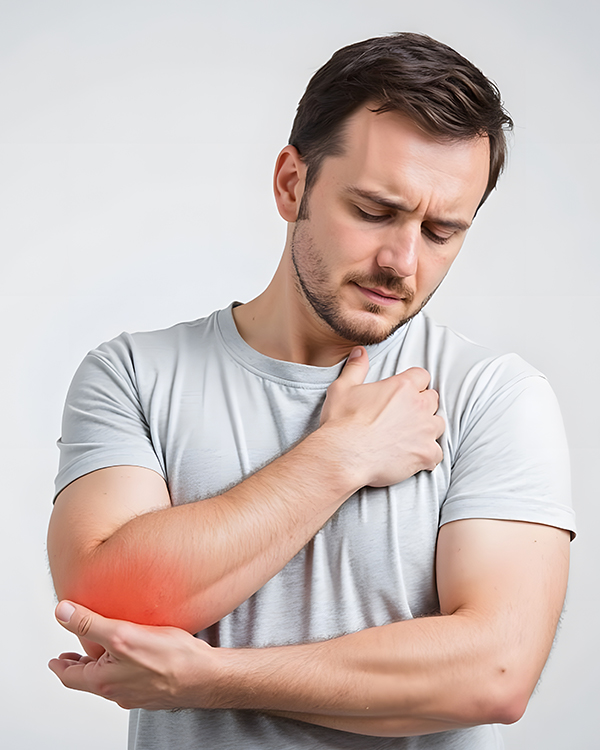
We support recovery for a wide range of elbow, forearm, and hand-interaction load pain patterns, including:


Lateral epicondylalgia (“tennis elbow”)
Medial epicondylalgia (“golfer’s elbow”)
Tendon overload or tears of the forearm muscle-tendon complex
Distal biceps or triceps tendon stress or irritation
Elbow joint stiffness or capsule pressure imbalance
Ligament sprains or laxity affecting motion confidence
Nerve-influenced elbow and forearm pain patterns (C5–T1 contribution into arm signaling)
Ulnar, radial, or median-nerve sensitivity and glide irritation around the elbow
Cubital Tunnel Syndrome
Olecranon or other fluid-pressure-influenced bursal stress loops
Post-injury elbow fear-response guarding under load
Long-standing or recurring elbow load intolerance that didn’t settle earlier in the right sequence
Complex pain patterns of the elbow

Wrist and hand symptoms are rarely just one small issue. They are often a sign that load, nerve behavior, circulation, fascia tension, and muscle timing from the neck to the fingertips are not working in harmony. Smarter recovery starts when these structures work together as a connected chain and are supported by biologically guided, regenerative care.
If conventional elbow care truly fixed the problem, why do so many people still avoid gripping, lifting, side-lying sleep, or repeated arm tasks because the pain keeps returning?

Not True Healing
If rest, braces, stretches, TENS / IFC, dry needling, massage, or standard strengthening were enough, why does pain return when steps increase, like holding, lifting, working, or trying again?
Why Pain Differs
If scans or tests look similar across patients, why can one person move pain-free while another stays irritated, guarded, or weak during daily tasks?
Motion Synergy Missing
Are injections or procedures really restoring tissue biology and motion synergy, or mainly muting pain while the load and nerve feedback stay sensitized?
Deeper Healing Needed
Can rehab create lasting recovery if it doesn’t restore pressure behavior, fascia cooperation, nerve calmness, tendon healing, and load symmetry as one system instead of many small, disconnected steps?
At Shiva Physical Therapy, we see traditional care as the foundation, and the S.H.I.V.A. Method as a systems-driven, tissue-rebuilding extension that supports regeneration and calms nerve sensitivity through a carefully sequenced recovery pathway for stronger, smoother outcomes, not limited to routine protocols alone.
 Focuses on the painful elbow or “weak forearm” in isolation
Uses rest, braces, taping, massage, stretches, strengthening, manual therapy, Dry needling and generic exercises
Progresses exercise mainly by time or protocol, not always biology
Pain relief often depends on repeated medication, injections, or passive resets
Best for early symptom comfort or mild flare situations
Focuses on the painful elbow or “weak forearm” in isolation
Uses rest, braces, taping, massage, stretches, strengthening, manual therapy, Dry needling and generic exercises
Progresses exercise mainly by time or protocol, not always biology
Pain relief often depends on repeated medication, injections, or passive resets
Best for early symptom comfort or mild flare situations
 Evaluates the entire shoulder-neck-rib-spine-elbow-wrist chain, including tissue biology, fascia tunnels, joints, nerves, posture, and load behavior
Enhances care using regenerative physical therapy principles with non-invasive neuromusculoskeletal treatments.
Uses phased progression guided by symptom irritability, pressure behavior, tissue healing ,fascia mobility , nerve calmness adaptation, and real load tolerance not one plan for everyone
Avoids dependency by supporting advance noninvasive modalities, natural neuroregulation, balanced collagen repair, and adaptive load re-education
Avoids dependency by supporting advance noninvasive modalities, natural neuroregulation, balanced collagen repair, and adaptive load re-education
Evaluates the entire shoulder-neck-rib-spine-elbow-wrist chain, including tissue biology, fascia tunnels, joints, nerves, posture, and load behavior
Enhances care using regenerative physical therapy principles with non-invasive neuromusculoskeletal treatments.
Uses phased progression guided by symptom irritability, pressure behavior, tissue healing ,fascia mobility , nerve calmness adaptation, and real load tolerance not one plan for everyone
Avoids dependency by supporting advance noninvasive modalities, natural neuroregulation, balanced collagen repair, and adaptive load re-education
Avoids dependency by supporting advance noninvasive modalities, natural neuroregulation, balanced collagen repair, and adaptive load re-education

We don’t force recovery by motion alone. We reset what previously limited progress so the elbow can return to smoother, stronger, symmetric, biology-paced functional movement.
Every plan is individualized and matched to your biology, your triggers, and your phase of healing.
Regenerative physiology
Neuro-modulation techniques
Fascia science applications
Autonomic balancing protocols
Personalized movement retraining
Instead of generic routines, we build a phased plan that matches your sensitivity, flare patterns, and lifestyle demands.

Choosing Shiva Physical Therapy means choosing a smarter, full-chain elbow recovery plan that restores comfort, calmness, mobility, and neural confidence, not just temporary pain reduction. When you begin, you can expect:
It’s not “just Physical Therapy. It’s a whole-chain, regenerative recovery strategy that helps your body return to stronger, smoother, calmer, and more confident movement for everyday life and sport.
Call Shiva Physical Therapy today and discover a smarter, regenerative approach that treats the root cause, not just the symptoms.
 Contact Us Today
 Same-day Appointment
 No referral needed