



The rotator cuff is a group of four small but powerful shoulder muscles and their tendons that work together to keep the shoulder stable and help it move in different directions. These include the supraspinatus (lifts the arm), infraspinatus (rotates the arm outward), subscapularis (rotates the arm inward), and teres minor (supports outward rotation and stability). Rotator cuff injury is a painful and common shoulder condition caused by overload, overuse, or sudden strain on the tendons and muscles that stabilize the shoulder. Despite being strongly associated with sports, this injury is not limited to athletes; it is frequently seen in caregivers, gym-goers, workers doing repetitive overhead tasks, or anyone exposed to poor loading patterns or abrupt pulling, lifting, or reaching forces.
This repeated or sudden stress can lead to microscopic fiber damage, inflammation, and tendon degeneration, most commonly affecting the supraspinatus tendon and other rotator cuff muscles the most vulnerable part of the rotator cuff because of its role in lifting and centering the shoulder joint. Limited blood flow, excess inflammation response, and unbalanced shoulder biomechanics may further reduce the tendon’s ability to tolerate load, leading to persistent pain, weakness, or restricted motion.

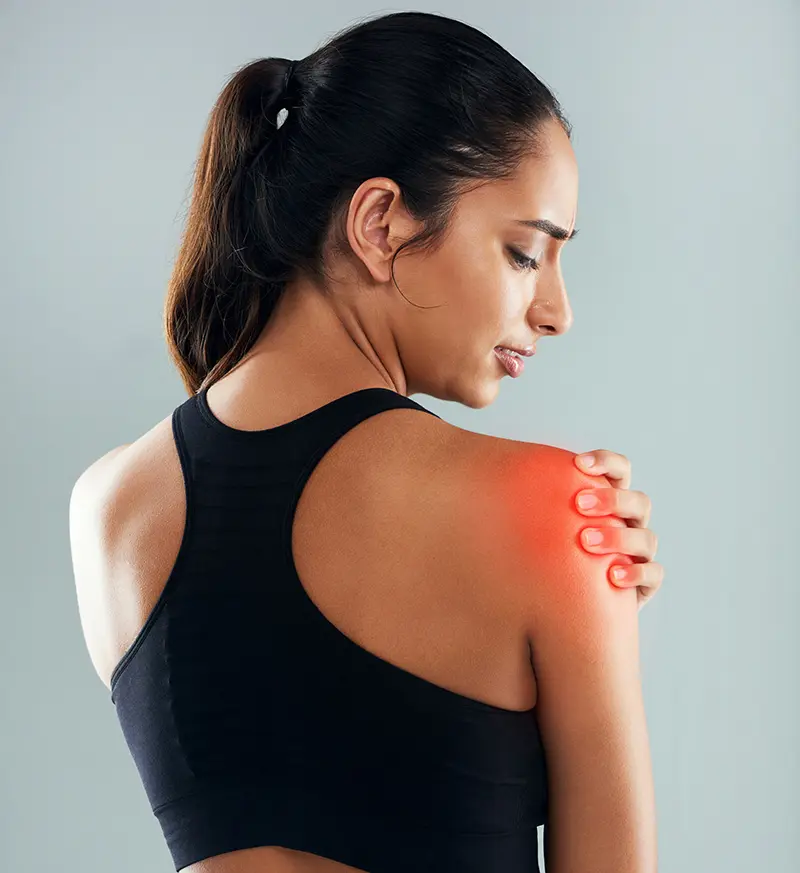

Sharp, catching, or deep aching pain inside or outside the shoulder
Pain that increases when lifting the arm, reaching, or lowering weight
Shoulder fatigue or weakness, especially in overhead movements
Difficulty with dressing, lifting, pushing, or throwing motions
Night pain or discomfort when lying on the affected side
Chronic compensation patterns
If not treated properly, rotator cuff pain can last for weeks to months, and in deeper or long-standing cases, even longer, limiting activity, sports participation, lifting capacity, and limiting both motion and confidence in natural shoulder movement.
If conventional shoulder care fully solved rotator cuff injuries, why are so many people still caught in ongoing pain, weakness, or repeated setbacks?
Surface Fixes Fail
If resting the shoulder, doing band exercises, and routine strengthening were enough, why do symptoms still return when you reach, lift, or try to sleep on the same side?
Not One-Size
If scans show similar cuff tears in many people, why does one person move and load pain-free, while another cannot raise their arm or sleep depending on standard care?
Tendon Healing Missing
Are cortisone injections or surgeries actually repairing and regenerating tendon fibers, or only lowering pain signals temporarily while load stress, inflammation, and movement coordination stay the same?
Full Restoration First
Can any rehab plan that doesn’t regenerate tissue biology, restore scapular stability, balance pressure behavior, improve circulation, and retrain coordinated load control, truly deliver a full and lasting recovery?
Rotator cuff injuries are not only tendon tears; except in cases of falls or accidents, most begin as multi-system stress responses. Pain may persist even when tissue repair is already progressing, because the shoulder sits in a stress-protection loop where nerve sensitivity stays high, breathing-rib-scapular pressure becomes misaligned, fascia tension increases, oxygen and circulation channels reduce, and muscle-joint coordination turns guarded instead of confident. This explains why one body with a similar scan can move freely and load pain-free, while another remains stuck in pain because the system around the tendon never resets into a true healing environment.
Conventional care often targets one layer at a time, resting what hurts, stretching what feels tight, or prescribing routine band and shoulder-core exercises for weak muscles. These methods may give short bursts of relief, but they rarely deliver lasting recovery, because real tendon healing also depends on calming nerve sensitivity, supporting healthy circulation, balancing load across the capsule–scapula–rib system, and retraining coordinated muscle control, not just strengthening one muscle group. That’s why true recovery, return-to-play, and pain-free daily movement requires restoring the entire cervical–thoracic–scapular–rib–fascial–rotator cuff chain, not just focusing on the painful shoulder itself.
The S.H.I.V.A. Method reflects the evolution of modern rehab by treating injury through a body-paced, whole-system recovery model, regenerating tissue, supporting natural repair, restoring motion quality, balancing tendon load behavior, improving neuromuscular coordination, enhancing sleep comfort, and rebuilding long-lasting confidence in movement.
At Shiva Physical Therapy, we recognize that traditional treatments play an important role in treating Rotator Cuff Injury. However, many patients need more than symptom management to reach lasting, full recovery. The S.H.I.V.A. Method was built as an additional, regenerative care framework that complements, not replaces, traditional treatment, but provides a deeper, more precise, and more regenerative approach to healing. Every treatment plan is fully individualized to your biology, healing phase, and movement limitations.
 Focuses on the cuff tendon or shoulder pain site in isolation
Relies on rest, stretching, Dry needling, heat/cold, cupping, manual therapy or routine shoulder strengthening regardless of stage
Provides rehab based mainly on symptom location (“supraspinatus pain,” “deltoid zone,” etc.)
Often paired with NSAIDs, steroids, or repeated cortisone injections for inflammation reduction
Strengthens muscles but may not address movement guarding, tissue injury, fascia stress or nerve output
Best for mild, short-term relief or foundational strengthening
Focuses on the cuff tendon or shoulder pain site in isolation
Relies on rest, stretching, Dry needling, heat/cold, cupping, manual therapy or routine shoulder strengthening regardless of stage
Provides rehab based mainly on symptom location (“supraspinatus pain,” “deltoid zone,” etc.)
Often paired with NSAIDs, steroids, or repeated cortisone injections for inflammation reduction
Strengthens muscles but may not address movement guarding, tissue injury, fascia stress or nerve output
Best for mild, short-term relief or foundational strengthening
 Evaluates the full kinetic chain: cervical & thoracic spine, scapula, ribs, shoulder capsule, fascia lines, nerve behavior & load distribution
Applies a 5-phase regenerative approach using modalities that progresses in the correct order: calming → mobilizing → stabilizing → integrating → activation
Treats the system that drives tissue stress, scapular motion control, cuff load tolerance, posture-breath harmony, and neuromuscular recruitment
Avoids dependency by supporting natural neuroregulation, balanced collagen repair, and adaptive load re-education
Rebuilds motion confidence, fascia-tendon signaling, tissue regeneration , nerve quietness, breathing pressure balance & load-tolerant functional activation
Ideal for athletes, caregivers, workers & recurring or long-standing injuries needing deep system-level recalibration
Evaluates the full kinetic chain: cervical & thoracic spine, scapula, ribs, shoulder capsule, fascia lines, nerve behavior & load distribution
Applies a 5-phase regenerative approach using modalities that progresses in the correct order: calming → mobilizing → stabilizing → integrating → activation
Treats the system that drives tissue stress, scapular motion control, cuff load tolerance, posture-breath harmony, and neuromuscular recruitment
Avoids dependency by supporting natural neuroregulation, balanced collagen repair, and adaptive load re-education
Rebuilds motion confidence, fascia-tendon signaling, tissue regeneration , nerve quietness, breathing pressure balance & load-tolerant functional activation
Ideal for athletes, caregivers, workers & recurring or long-standing injuries needing deep system-level recalibration

Rotator cuff healing begins when joint mechanics, nerve calmness, fascia continuity, rib-spine-scapula coordination, tissue regeneration, and functional load symmetry support the tendon, not fight it. The S.H.I.V.A. Method restores harmony across the cervical-thoracic-scapular-ribs-fascia-cuff chain so tissue healing, strength, motion, and confidence progress together, not separately.
Every plan is individualized and matched to your biology, your triggers, and your phase of healing.

Regenerative physiology
Neuro-modulation techniques
Fascia science applications
Autonomic balancing protocols
Personalized movement retraining
Instead of generic routines, we build a phased plan that matches your sensitivity, flare patterns, and lifestyle demands.

Choosing Shiva Physical Therapy means choosing smarter shoulder recovery that restores systems, not just symptoms. When you begin your rotator cuff recovery with this adaptive model, you can expect:
Our goal is not just to calm symptoms, but to rebuild shoulder confidence and capacity from the inside out. By guiding healing through each phase and restoring how the entire shoulder system works together, we help you return to activity with strength, trust, and long-term durability, without fear of relapse.
It’s a regenerative return-to-activity framework that helps your rotator cuff heal, move smoothly, and stay strong for the long run.

Call Shiva Physical Therapy today and discover a smarter, regenerative approach that treats the root cause, not just the symptoms.
 Contact Us Today
 Same-day Appointment
 No referral needed