



Your upper and lower back are not just “muscles” or “discs”; they are part of a complex stability-and-movement system that connects your head, ribs, pelvis, hips, and legs. Healthy spine function depends on well-coordinated behavior between vertebrae, discs, facet joints, ligaments, muscles, fascia, nerves, and breathing mechanics that share load with the ribs and pelvis every time you sit, stand, lift, twist, or walk.
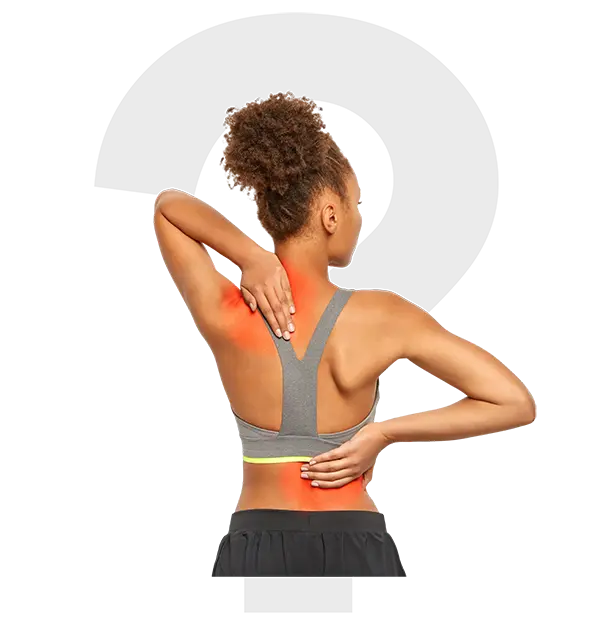
Upper and lower back pain can show up in many ways

A dull ache across the mid-back or low back after sitting or standing
Sharp pain with bending, lifting, twisting, or rolling in bed
Stabbing or “pinching” pain on one side of the spine or near the shoulder blade
Burning, pulling, or band-like tightness across the ribs or low back
Pain that travels into the buttock, hip, thigh, or leg (sciatica/radiculopathy)
Morning stiffness that slowly eases, or end-of-day heaviness and fatigue
Difficulty sleeping, turning in bed, or getting up from a chair or the floor


Many people are surprised to learn that back pain is rarely just a single “bulging disc,” “pulled muscle,” or “arthritic level.” Imaging often shows disc changes, arthritis, or “degeneration” even in people who have no pain at all. What usually keeps pain going is the way the whole system is behaving, how joints move (or don’t move), how discs and facets are loaded, how the ribs and pelvis share pressure, how fascia glides, how nerves are firing, and how stress, breathing, and posture keep the body in protection mode instead of healing mode.
If inflammation stays high, blood flow slows, fascia stiffens, or muscles keep bracing to protect irritated joints, your back can feel locked, tender, weak, or unstable. Over time, this can trigger recurring flare-ups, disc irritation, sciatica, spinal stenosis symptoms, rib or thoracic tightness, and low back pain that never seems to fully “let go” even after rest, pills, or standard exercises.
At Shiva Physical Therapy, we respect traditional spine care exercise, manual therapy, medication when appropriate, and activity modification. The S.H.I.V.A. Method was created as a regenerative physical therapy extension to that care, not a replacement. It adds a smarter, whole-system framework that improves circulation, fascia health, tissue healing, nerve behavior, load sharing, and neuromuscular control, helping your upper and lower back recover more naturally, calmly, and sustainably.
At Shiva Physical Therapy, we support recovery for a wide range of spine-related pain and movement issues, including both common and under-recognized conditions:


Mechanical low back pain and thoracic back pain
Lumbar and thoracic disc bulge, protrusion, or herniation
Discogenic back pain and vertebrogenic pain (endplate-related irritation)
Lumbar radiculopathy and sciatica
Spinal stenosis (narrowing of the spinal canal or foramina)
Spondylosis (age-related changes) and facet joint irritation/arthropathy
Spondylolisthesis and segmental instability
Sacroiliac (SI) joint dysfunction and pelvic rotation asymmetry

Myofascial pain syndromes of the upper and lower back
Postural and “desk-related” back pain
Thoracic/rib joint dysfunction, T4 syndrome–like patterns, and rib–breathing load issues
Scheuermann’s disease–related thoracic changes (load management)
Post–spinal surgery pain (post-laminectomy or fusion load adaptation)
Scoliosis-related pain or asymmetrical load patterns (adult and adolescent)
Chronic or recurrent back pain after failed short-term relief from injections or routine PT
If conventional back treatments truly worked, why are so many people still limiting lifting, bending, or walking because of ongoing upper or lower back pain?
Temporary Relief Only
If rest, pain pills, heat/ice, core routines, basic stretches, occasional adjustments, or decompression were enough, why does pain keep coming back when you sit longer, lift again, drive farther, or try to be more active?
Same Scan, Different Outcomes
If imaging shows similar disc bulges or arthritic changes in many people, why can one person move and work pain-free while another struggles to stand, sleep, or walk without discomfort?
Healing Still Missing
Are injections, muscle relaxers, or repeated “quick fix” treatments truly restoring disc and joint health, fascia glide, tissue healing, and nerve calmness, or mostly muting pain while overload and protection patterns continue underneath?
Beyond Basic Rehab
Can any rehab plan that doesn’t restore spinal joint motion, rebalance spine–pelvis–hip load, support disc, tissue healing and facet health, calm nerve sensitivity, and retrain whole-chain movement really create durable, long-term relief?
Upper and lower back pain are not just about a single “weak muscle,” “tight band,” or “bad disc.” They usually reflect a whole-system disturbance involving lumbar and thoracic discs and joints, facet loading patterns, rib and pelvic mechanics, fascia lines that link the spine into the hips and shoulders, nerve communication through the spinal cord and nerve roots, breathing strategy, and your stress/autonomic tone. When any part of this chain is overloaded, inflamed, or restricted, it can disturb everything around it and lock the body into a loop of stiffness, pain, nerve irritation, fatigue, and guarded motion.
Most conventional rehab addresses these layers one piece at a time: stretching what feels tight, performing general “core” and back strengthening, doing repeated extensions or flexions, resting during flare-ups, or relying on periodic spinal manipulation or traction. While these can ease symptoms for a while, they often don’t remove the deeper barriers that keep the problem coming back: abnormal joint and disc pressure, chronic facet irritation, rib-cage stiffness, SI and pelvic load asymmetry, fascia tension that restricts normal glide, irritated nerve roots, altered breathing mechanics, and long-standing protective motor patterns that keep the back in “brace mode” even after the original injury fades.
Modern regenerative physical therapy and spine science show that real back recovery requires more than symptom control. It requires:

Supporting cellular repair and disc/soft tissue health
Rebalancing thoracic–lumbar–pelvis–hip mechanics
Recalibrating neuromuscular timing and trunk–hip control
Improving breathing mechanics and rib–spine cooperation
Calming sensitized nerves (including lumbar and thoracic nerve roots)
Restoring smooth joint glide, fascia harmony, and load sharing across the whole chain
By addressing not only the painful segment in your back but also the upper back, ribs, pelvis, hips, fascia, and movement behavior, we help your body recover more naturally, reducing reliance on pain medications, injections, or repeated “quick fix” approaches whenever possible.
At Shiva Physical Therapy, we recognize that traditional treatments can play an important role in back care. However, many people need more than symptom management to reach durable, high-function recovery. The S.H.I.V.A. Method was built as an additional, regenerative care framework that complements, not replaces, traditional treatment. It adds deeper, more precise, and more system-based support to restore tissue health, optimize spine–pelvis–hip mechanics, reduce nerve irritation, and rebuild efficient, confident movement.
 Focuses on localized back pain, “tight muscles,” or weak core.
Relies on rest, generic stretches, heat/ice, massage, traction, manipulations, manual therapy ,decompression ,dry needling , cupping, or TENS / IFC for symptom relief
Progresses exercises based on protocol or time, not always on biological readiness
Often emphasizes “core strengthening” and postural corrections.
Pain relief may depend on ongoing medication, injections, or repeated manual “fixes”
Best for early supportive rehab or mild symptoms
Focuses on localized back pain, “tight muscles,” or weak core.
Relies on rest, generic stretches, heat/ice, massage, traction, manipulations, manual therapy ,decompression ,dry needling , cupping, or TENS / IFC for symptom relief
Progresses exercises based on protocol or time, not always on biological readiness
Often emphasizes “core strengthening” and postural corrections.
Pain relief may depend on ongoing medication, injections, or repeated manual “fixes”
Best for early supportive rehab or mild symptoms
 Evaluates the entire head–thoracic–lumbar–pelvis–hip chain, including discs, joints, fascia, nerves, breathing, posture, tissue injury and load behavior
Enhances care with precision regenerative modalities and non-invasive neuromodulation that improve circulation, nerve behavior, fascia health, and tissue repair
Uses a phased, biology-matched framework that moves from pain control → decompression & motion → neuromuscular retraining → load tolerance → higher-level performance
Rebuilds movement precision, breathing rhythm, spine–pelvis–hip integration, and calm nervous system support and heal tissue so all muscles can fire in a coordinated, efficient way
Aims to reduce dependence on medications and passive care by activating your body’s natural regenerative and neuromodulatory systems
Ideal for stubborn, recurring, or complex upper & lower back pain where deeper system-level recalibration and tissue support are needed
Evaluates the entire head–thoracic–lumbar–pelvis–hip chain, including discs, joints, fascia, nerves, breathing, posture, tissue injury and load behavior
Enhances care with precision regenerative modalities and non-invasive neuromodulation that improve circulation, nerve behavior, fascia health, and tissue repair
Uses a phased, biology-matched framework that moves from pain control → decompression & motion → neuromuscular retraining → load tolerance → higher-level performance
Rebuilds movement precision, breathing rhythm, spine–pelvis–hip integration, and calm nervous system support and heal tissue so all muscles can fire in a coordinated, efficient way
Aims to reduce dependence on medications and passive care by activating your body’s natural regenerative and neuromodulatory systems
Ideal for stubborn, recurring, or complex upper & lower back pain where deeper system-level recalibration and tissue support are needed

We don’t try to “crack the back loose,” “just stretch it,” or “strengthen the core” and hope the pain goes away. We reset the systems that support spine health, tissue healing, load distribution, joint mechanics, fascia behavior, nerve calmness, breathing, and movement coordination so your back can work with less stress and more resilience.
Every plan is individualized and matched to your biology, your triggers, and your phase of healing.

Regenerative physiology
Neuro-modulation techniques
Fascia science applications
Autonomic balancing protocols
Personalized movement retraining
Instead of generic routines, we build a phased plan that matches your sensitivity, flare patterns, and lifestyle demands.
 Doctor Consultation">
Choosing Shiva Physical Therapy means choosing a smarter, regenerative path for upper and lower back pain, not just a temporary management of symptoms.
Our goal is not just to reduce back pain, but to help you move with ease, confidence, and control again. By addressing the true sources of dysfunction and guiding your body through a regenerative, phase-specific healing process, we focus on lasting improvement, so you can sit, stand, work, exercise, and live your life without constant worry about pain returning.
It’s a regenerative, whole-system recovery model designed to help your upper and lower back heal from within naturally and sustainably.

Call Shiva Physical Therapy today and discover a smarter, regenerative approach that treats the root cause, not just the symptoms.
 Contact Us Today
 Same-day Appointment
 No referral needed