
Spinal manipulation is a skilled manual therapy technique in which a physical therapist applies a controlled, high-velocity, low-amplitude (HVLA) thrust to a specific spinal segment. The thrust is delivered at the end range of a joint's available motion with rapid speed and minimal depth, typically producing an audible popping sound as gas is released from the joint fluid.
It is one of the most extensively studied manual therapy interventions in musculoskeletal rehabilitation. It is recommended in multiple international clinical practice guidelines for low back pain, neck pain, and thoracic spine disorders. Unlike spinal mobilization, which uses slower oscillatory forces, the HVLA thrust takes the joint briefly past its elastic barrier, producing neurophysiological effects that slower techniques may not achieve to the same degree.
At Shiva Physical Therapy, spinal manipulation is applied within a comprehensive regenerative framework. It is selected based on a detailed clinical examination and performed within the licensed scope of physical therapy practice.
Spinal manipulation works through a combination of biomechanical and neurophysiological mechanisms that create rapid changes at the local joint level, the segmental spinal cord level, and the brain level simultaneously.

Brief separation (gapping) of the facet joint surfaces, confirmed by imaging studies, stretching the joint capsule and periarticular tissues
Release of intra-articular gas from synovial fluid, producing the characteristic audible cavitation
Disruption of intra-articular adhesions and restoration of normal accessory joint motion
Reduction in segmental spinal stiffness
Rapid stimulation of joint and muscle mechanoreceptors, sending a burst of afferent input to the spinal cord that activates segmental inhibitory interneurons and produces reflexive muscle relaxation
Activation of descending pain inhibitory pathways, producing temporary hypoalgesia (reduced pain sensitivity) in the treated region
Reduction in temporal summation of pain (wind-up), decreasing pain amplification at the spinal cord level
Autonomic nervous system modulation, including changes in sympathetic activity and regional blood flow
Improved cortical sensorimotor processing, enhancing the brain's ability to perceive and control movement at the treated segment

A 2025 JOSPT network meta-analysis found that spinal manipulative therapy produces clinically meaningful improvements in pain and disability for adults with spine pain. These combined mechanisms explain why manipulation often produces immediate, noticeable changes within a single session.
The HVLA thrust creates a mechanical and sensory event that produces effects at multiple levels of the nervous system simultaneously, in a way that slower, lower-force techniques cannot replicate. It activates high-threshold mechanoreceptors that respond specifically to rapid joint movement, triggering reflexive muscle inhibition and descending pain modulation. This creates an immediate neurophysiological window of reduced pain, decreased muscle guarding, and improved range of motion that can be leveraged for therapeutic exercise and functional training, making manipulation not just a treatment in isolation, but a catalyst for more effective rehabilitation.

Immediate reduction in spinal pain intensity
Rapid improvement in spinal range of motion
Decreased paraspinal muscle guarding and protective tension
Improved functional mobility and ease of movement
Reduction in referred pain and cervicogenic headache
Enhanced proprioception and body awareness
Improved tolerance of therapeutic exercise and progressive loading
Greater confidence in movement and reduced fear of movement

A JAMA systematic review of 26 RCTs found moderate-quality evidence that spinal manipulation significantly improves pain and function for acute low back pain, with benefits comparable to nonsteroidal anti-inflammatory medications. A 2024 systematic review found that HVLA cervical manipulation does not impose an increased risk of mild or moderate adverse events compared to control interventions. Results are individual and not guaranteed.

Applied to address segmental hypomobility, cervicogenic headache, and mechanical neck pain. Cervical techniques are performed with precise positioning, minimal force, and careful pre-manipulative screening including assessment of vertebral artery integrity and neurological status.
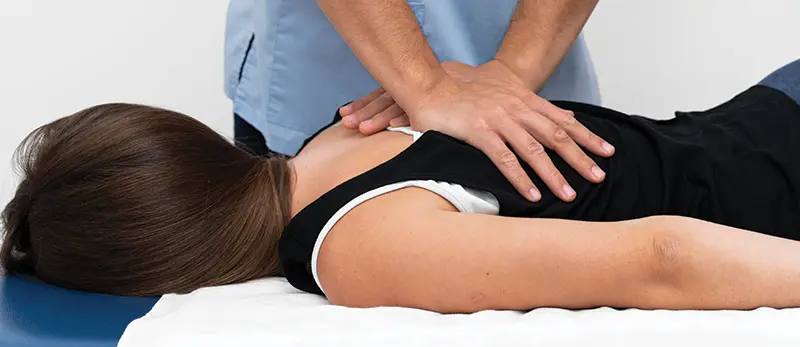
One of the most commonly applied manipulation techniques in physical therapy. The thoracic spine is well-protected by the rib cage, making it a lower-risk application. Used for thoracic pain, rib dysfunction, postural restriction, and as an indirect approach for cervical and shoulder conditions.

One of the most extensively studied HVLA applications. Multiple clinical practice guidelines recommend spinal manipulation as a first-line intervention for acute and subacute low back pain. Techniques include side-lying rotational thrust and other positioning strategies based on the direction of restriction.

Addresses hypomobility and mechanical dysfunction at the pelvic ring. Indicated when clinical examination identifies sacroiliac joint dysfunction contributing to low back, pelvic, or lower extremity symptoms.


Acute, subacute, and chronic low back pain
Mechanical neck pain
Cervicogenic and tension-type headache
Thoracic spine pain and stiffness
Rib dysfunction and costovertebral joint restriction
Sacroiliac joint dysfunction
Lumbar and cervical radiculopathy (as part of a multimodal approach)
Spinal segmental hypomobility contributing to movement dysfunction
Thoracic restriction contributing to shoulder or scapular dysfunction
Regional pain syndromes with identified spinal joint dysfunction
Within The S.H.I.V.A. Method, spinal manipulation is not applied routinely. It is selected based on comprehensive clinical examination and specific biomechanical and neurophysiological indications. Our approach focuses on when manipulation is indicated, which segment to target, and when other interventions are more appropriate.
Manipulation is considered when:
Spinal manipulation serves as a catalyst that creates an immediate neurophysiological window of improved function. This window is then leveraged through targeted exercise, neuromuscular training, and functional movement restoration. Manipulation alone does not produce long-term results. It is the combination of manipulation with subsequent active rehabilitation that creates durable improvement.
The manipulation itself takes only seconds. The complete assessment, positioning, and thrust process typically takes 5 to 10 minutes within a full treatment session.
Spinal manipulation is applied as clinically indicated, not on a fixed schedule. Some patients benefit from manipulation at consecutive sessions during the acute phase, while others may receive it once.
Most patients who respond to manipulation notice significant improvement within 1 to 4 sessions. Manipulation is not intended as a recurring, long-term intervention.
You may feel a brief stretch or pressure followed by a quick thrust. An audible pop frequently accompanies the technique. The thrust is fast but controlled, and most patients describe it as brief and tolerable
No special preparation is required. Wear comfortable clothing. Your clinician will explain the procedure, obtain informed consent, and answer any questions before performing the manipulation.
It is common to feel immediate improvement in mobility, reduced stiffness, and decreased pain. Some patients experience mild localized soreness for 12 to 24 hours, similar to post-exercise tenderness. This resolves quickly.
Spinal manipulation may be appropriate for individuals who:

Have acute, subacute, or chronic spinal pain with identified segmental joint hypomobility
Present with restricted spinal range of motion that correlates with segmental findings
Experience cervicogenic headache with cervical joint involvement
Show significant paraspinal guarding limiting participation in active rehabilitation
Have thoracic stiffness contributing to neck, shoulder, or rib cage dysfunction
Need rapid restoration of joint mobility to progress in their rehabilitation program
Spinal manipulation is contraindicated in the presence of spinal fracture, severe osteoporosis, spinal cord compression, cauda equina syndrome, vertebral malignancy, active spinal infection, severe inflammatory arthritis, vertebral artery dissection (cervical), and unstable spinal segments. Relative contraindications include advanced degenerative joint disease, disc herniation with progressive neurological deficit, anticoagulant therapy, and patient refusal. The decision to manipulate is always based on comprehensive clinical examination, appropriate screening, and informed consent.
Yes. Physical therapists are licensed healthcare professionals trained in the evaluation and treatment of musculoskeletal conditions, including spinal manipulation. It is within the scope of physical therapy practice in the United States. Dr. Siva Parnam has advanced post-doctoral training in spinal manipulative therapy.
The effectiveness of spinal manipulative therapy procedures for spine pain does not depend on the application procedures: a systematic review and network meta-analysis.
Read Full StudyAssociation of spinal manipulative therapy with clinical benefit and harm for acute low back pain: systematic review and meta-analysis.
Read Full StudyBenefits and harms of spinal manipulative therapy for treating recent and persistent nonspecific neck pain: a systematic review with meta-analysis.
Read Full StudySpinal manipulative therapy for nonspecific low back pain: does targeting a specific vertebral level make a difference?
Read Full StudyEfficacy of spine high-velocity low-amplitude thrust manipulations in patients with radiculopathy: a systematic review with meta-analysis.
Read Full StudyEffectiveness of manual joint mobilization techniques in the treatment of nonspecific neck pain: systematic review with meta-analysis.
Read Full StudySystematic review on biomechanical effects of high-velocity, low amplitude spinal manipulation.
Read Full StudyAdverse events after cervical spinal manipulation: a systematic review and meta-analysis of randomized clinical trials.
Musculoskeletal Science and Practice, 27(4), 185-201.
Evidence-based treatment recommendations for neck and low back pain across Europe: a systematic review of guidelines.
European Journal of Pain, 25(2), 275-295. →
Prevention and treatment of low back pain: evidence, challenges, and promising directions.
Lancet, 391(10137), 2368-2383.
The mechanisms of manual therapy in the treatment of musculoskeletal pain: a comprehensive model.
Manual Therapy, 14(5), 531-538.
Changes in pain sensitivity following spinal manipulation: a systematic review and meta-analysis.
Journal of Electromyography and Kinesiology, 22(5), 752-767.
Neurophysiological effects of spinal manipulation.
The Spine Journal, 2(5), 357-371..
A clinical prediction rule for classifying patients with low back pain who demonstrate short-term improvement with spinal manipulation.
Spine, 27(24), 2835-2843.