A Whole-System Model for Musculoskeletal Healing. Regenerative Physical Therapy is a non‑invasive, whole-system approach to musculoskeletal rehabilitation that supports healing at three connected levels: the tissue, the nervous system, and the mind. It uses advanced therapeutic technology, manual therapy, progressive loading, and pain neuroscience education to restore function and produce lasting recovery without injections, PRP, stem cells, or surgery.
Key Takeaways
Something is quietly changing in how we treat musculoskeletal pain and injury.
More and more people are walking into clinics with a version of the same story:
For a long time, the path forward has felt narrow. Rest. Medication. Stretch. Strengthen. Some manual therapy. If that does not work, move up to injections. If that still does not work, consider a procedure or surgery or live with it.
Those options all have a place. Traditional physical therapy, medical care, injections, and surgery can each be the right choice for the right condition. But the science of healing has moved forward, and it now tells us something important. Lasting recovery usually takes more than reducing pain or strengthening a weak spot.
Healing in the body is not only mechanical. It is biological, neurological, psychological, and functional all at once. Tendons, joints, fascia, nerves, muscles, circulation, inflammation, the autonomic nervous system, the way the brain maps the body, beliefs about pain, sleep, stress, nutrition, and how tissue is loaded over time all shape whether a person heals fully or keeps struggling.
This is where Regenerative Physical Therapy comes in.
Regenerative Physical Therapy is not a replacement for medicine, and it is not a shortcut. It is a structured, non‑invasive approach that supports the body’s own repair systems while rebuilding movement, strength, confidence, and function. It fills the gap between standard rehabilitation and invasive procedures, and it is the foundation of the care we provide at Shiva Physical Therapy.
Regenerative Physical Therapy is a non‑invasive, biology-informed model of rehabilitation. It supports the body’s natural healing environment using advanced therapeutic technology, skilled manual therapy, neuromuscular retraining, progressive loading, pain neuroscience education, autonomic regulation, and recovery strategies drawn from a person’s daily life.
It does not involve PRP injections, stem cell injections, blood-derived treatments, surgery, other invasive procedures, or medication-based pain management.
Instead, it uses focused, conservative interventions to support the systems that actually drive recovery: cellular metabolism, microcirculation, inflammation control, nerve function, fascia and connective tissue mobility, remodeling of the tissue scaffold, neuromuscular control, autonomic balance, the way pain is processed, movement confidence, and the tissue’s capacity to handle load.
Here is the key difference,
It also asks sharper questions.
Why is this tissue not healing? Is the nervous system sensitized? Is this person afraid to move? Is the tissue ready to be loaded? Are inflammation, circulation, sleep, or stress slowing things down? Is this pain coming mainly from the tissue, the nerves, or a sensitized pain system? Is this a case for conservative care, or does it need a medical referral?
That is what makes this more than a set of advanced tools. It is a clinical decision-making framework.
Most musculoskeletal care today still works the way it did twenty years ago. Stretch, strengthen, add some manual therapy and a few passive treatments. The techniques have been refined, and the certifications have multiplied, but the underlying framework has not changed much.
So patients move better and feel better for a while. Then the symptoms return. Low back pain alone is reported to recur in close to seventy percent of people within a year of finishing traditional rehabilitation.
Why does this keep happening? Often because the tissue itself was never fully restored. The tendon is still degenerated. The fascia is still restricted. The nervous system is still on high alert. The biological environment never actually changed, so the problem comes back. Functional improvement without biological repair is rarely durable.
Good regenerative care comes down to three simple questions. They sound basic, but the answers are what separate a real clinical system from a room full of expensive machines.
What to use? Different regenerative technologies support healing in different ways by improving tissue repair, reducing inflammation, enhancing circulation, or regulating nerve function. The right treatment is selected based on the patient's condition, tissue health, and stage of recovery.
How to use it? Recovery is influenced not only by the treatment itself but also by how it is applied. Proper dosing, timing, sequencing, and integration with manual therapy and exercise are critical to achieving consistent,
long-lasting results.
When to use it? Healing follows a biological sequence of inflammation, repair, and remodeling. Applying the right intervention at the right phase helps optimize recovery, while premature or delayed treatment can slow progress. This is why Regenerative Physical Therapy follows a simple principle: heal first, load second, perform third.
When these three questions are answered correctly, regenerative care becomes a structured, evidence-informed clinical approach rather than simply a collection of advanced technologies.
Regenerative Physical Therapy is built on two layers that work together. Four pillars describe what is always being addressed. Three phases describe how that care is sequenced over time. The same structure gives clinicians the depth they need and gives patients a clear picture of the plan. Our proprietary S.H.I.V.A. Method is the clinical system we use to put this structure into practice for each patient.
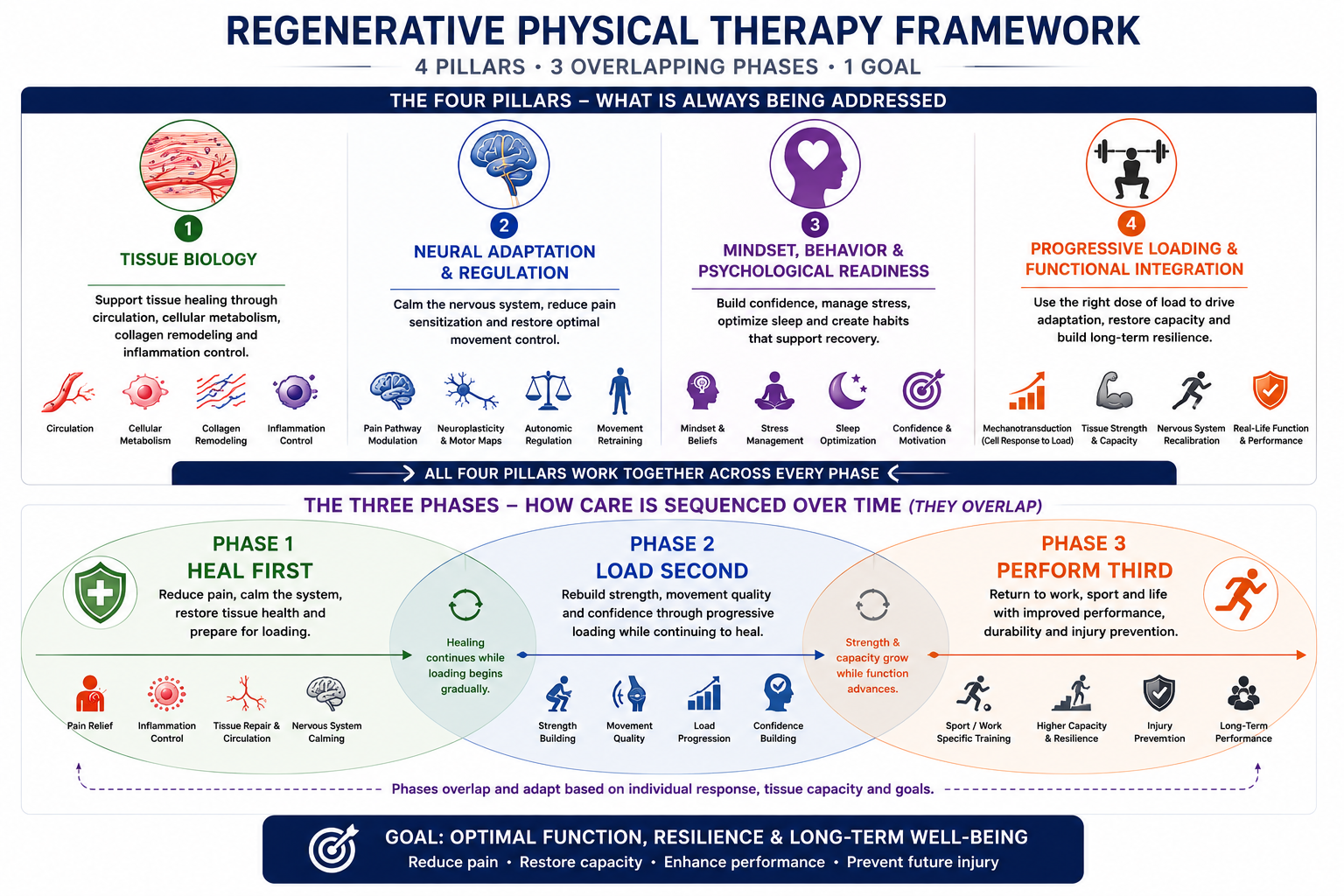
This is the physical substrate of injury and healing: tendons, ligaments, muscles, fascia, joints, cartilage, bone, nerves, connective tissue, blood vessels, and the extracellular matrix that holds it all together.… Read More →
This is the role the brain and nervous system play in pain, movement, and recovery. Chronic pain produces real, measurable changes in the nervous system. Pain pathways become sensitized.… Read More →
This is the cognitive and emotional layer of recovery, and it is a root cause, not an afterthought. Recovery is influenced by mindset, stress, sleep, and confidence in movement.… Read More →
This is the pillar that drives adaptation across all the others: mechanical load. Loading is one of the most powerful regenerative signals in all of biology.… Read More →
Once these four pillars are in place, treatment progresses through three evidence-informed phases designed to maximize healing and long-term recovery.
These are not rigid stages with hard lines between them. They overlap, and they often run together.
The Four Pillars and Three Phases describe what we address and how we sequence it. The S.H.I.V.A. Method is the clinical system we use to put that structure into practice for each patient at Shiva Physical Therapy.
It maps your specific tissue condition, nervous system state, psychological readiness, and functional goals into a structured, sequenced plan. That plan is not fixed. It evolves as your biology changes, as your capacity builds, and as you move from one phase of healing to the next.
No two patients heal the same way. A plan that does not account for where your tissue actually is, what your nervous system is doing, and what your body is ready to handle is not a plan. It is a template. The S.H.I.V.A. Method is built to do something more precise than that.
This is what separates a room full of advanced technology from a clinical system that produces lasting results.
Want to see how the S.H.I.V.A. Method applies to your condition?
Book a discovery consultation with our clinical team at Shiva Physical Therapy. Tell us what you have been dealing with, and we will tell you honestly what your tissue needs, what phase of healing you are in, and whether Regenerative Physical Therapy is the right next step for you.
To understand why Regenerative Physical Therapy matters so much in modern care, it helps to understand what is actually happening inside your body as you get older. Three things are quietly working against your healing.
Your body’s natural ability to heal declines steadily with age. Aged tissues heal more slowly. They produce a
less-organized type of collagen during repair, Type III instead of the stronger Type I. They have reduced blood supply and less oxygen delivery. And they are influenced by chronic, low-grade inflammation called inflammaging, which silently drives further degeneration over time.
Traditional treatments such as stretching, strengthening, and manual therapy may provide temporary relief but often do not address the deeper biological changes that occur with aging. Regenerative Physical Therapy is designed to support tissue healing by targeting these underlying processes.
Inside your tendons, joints, muscles, ligaments, and connective tissues are special cells called stem and progenitor cells. They are responsible for repairing tissue when it is damaged. They are your body’s healing crew.
As we age, more repair cells become senescent, meaning they stop repairing tissue and begin releasing inflammatory signals that slow healing. As a result, injuries recover more slowly, and tissue becomes more vulnerable to degeneration.
Every tissue in your body sits within a structure called the extracellular matrix, or ECM. Think of it as the scaffold that gives your tissue its strength, organization, and elasticity. In young, healthy tissue, this scaffold is
well-organized, hydrated, and adaptive. It lets cells communicate, nutrients flow, and forces distribute properly.
As you age, three things happen to this scaffold. With age, collagen becomes disorganized, tissues stiffen, and the extracellular matrix loses its ability to repair and adapt efficiently. These changes reduce tissue resilience and slow recovery after injury. Regenerative Physical Therapy uses targeted tools that support this scaffold biologically, helping to restore organization and adaptability rather than simply pushing through restriction.
Modern tissues, especially aging or chronically injured tissues, often need more than exercise alone. While movement remains essential, advanced therapies can support healing by improving circulation, cellular activity, inflammation control, nerve regulation, and tissue repair.
This is where modern therapeutic technology comes in. Used inside a clinical framework, advanced treatments become a force multiplier for healing across all three domains: tissue, nervous system, and mind. These technologies span several broad categories, each designed to support a different layer of the healing process.
| Treatment Category | How It Supports Healing | Common Applications |
|---|---|---|
| Mechanical Energy Therapies | Deliver controlled waves into tissue to stimulate collagen remodeling, new blood vessel growth, and stem cell activation. | Acute injuries, chronic tendinopathies, fascial restriction, degenerative conditions |
| Light-Based Therapies (Photobiomodulation) | Use specific wavelengths of light to drive mitochondrial activity, modulate inflammation, and support cellular energy at depth. | Muscle strains, tendon injuries, joint pain, post-surgical recovery |
| Electromagnetic and Radiofrequency Therapies | Use targeted energy fields to influence cell membrane behavior, deep tissue temperature, microcirculation, and metabolism, reaching layers manual therapy alone cannot. | Chronic pain, joint dysfunction, deep soft tissue injuries |
| Neuromodulation and Electrotherapy | Influence nerve regulation, autonomic balance, central pain processing, and neuromuscular control in ways exercise cannot reach. | Acute injuries, chronic pain, nerve sensitization, complex post-injury cases |
| Advanced Manual and Biomechanical Therapies | Extend the precision and depth of skilled hands-on therapy, allowing clinicians to address joint mechanics, fascial layers, and soft tissue with greater control and consistency. | Joint stiffness, fascial dysfunction, musculoskeletal pain, movement restriction |
| Structured Loading and Movement Therapy | Apply progressive, evidence-based loading principles to drive adaptation at the level required to truly change tendon, joint, and muscle capacity. | Tendon rehabilitation, sports injuries, functional recovery, return to work and sport |
| Neuroplasticity and Cognitive Interventions | Retrain the brain and the person's relationship to pain and movement. Includes pain neuroscience education, motor imagery, graded exposure to feared movement, sensory retraining, breathing and autonomic regulation, balance and coordination work, and behavioral reframing. | Chronic and persistent pain, fear of movement, balance deficits, neurological rehabilitation |
EMTT (Electromagnetic Transduction Therapy) applied with a Storz Medical Magnetolith device - one of the electromagnetic and radiofrequency therapies described above.
As regenerative rehabilitation continues to evolve, new technologies and treatment approaches will emerge. However, lasting results depend less on the device itself and more on selecting the right treatment at the right stage of healing. When combined with skilled clinical decision-making, advanced therapies, movement, and patient education work together to support long-term recovery and improved function.
While the foundations of rehabilitation - exercise, manual therapy, and progressive loading - remain essential, Regenerative Physical Therapy enhances them with modern biological and technology-assisted approaches. This integrated model helps patients recover more efficiently while reducing reliance on invasive procedures.
And who Regenerative Physical Therapy serves has expanded. It is no longer only for chronic, degenerative, or stubborn cases. It is now one of the most effective non‑invasive options available for athletes, active people, and weekend warriors of every age who want to recover faster than conventional rehabilitation alone allows. A high school soccer player with a hamstring strain before playoffs. A sixty-five-year-old hiker recovering from an ankle sprain. A young gymnast with a tendon overuse injury. A weekend cyclist who tweaked a knee. A professional athlete maximizing recovery between competitions. What unites them is one question: is there a way to heal faster, deeper, and more completely?
Conditions that once required injections are now routinely resolving with Regenerative Physical Therapy. Surgeries that once felt inevitable are being delayed or avoided. Chronic problems that conventional rehabilitation could not fully resolve are responding. Athletes are returning to competition ahead of standard timelines. This is not about claiming that every tool is equally proven for every condition. It is about combining the best available evidence, biological plausibility, clinical reasoning, patient goals, and honest progress tracking. And it reflects a real, global shift in tissue biology, regenerative medicine, neuroplasticity, pain science, and conservative musculoskeletal care.
As people live longer and remain active later in life, the demand for effective non-surgical treatment continues to grow. Modern research has shown that tissues can adapt, the nervous system can change, and recovery can be improved through biology-informed, whole-person rehabilitation. Regenerative Physical Therapy reflects this shift by combining evidence-based technology, movement, and patient-centered care.
Regenerative Physical Therapy is used worldwide as a first-line conservative option for many of the most common and most stubborn musculoskeletal and pain conditions, as well as for acute sports and overuse injuries, including:
Every patient and every condition is different. But the unifying principle is consistent: when the biology of the tissue, the function of the nervous system, and the state of the mind are all supported together, healing tends to follow.
Patients who complete Regenerative Physical Therapy programs often describe something different from conventional rehabilitation. They heal from chronic tendinopathies that did not respond to months of standard therapy. They recover from acute and sports injuries in a fraction of the usual time. They avoid scheduled injections because the pain finally resolves at the tissue level. They postpone or cancel surgical consultations because function returns without an invasive procedure. Athletes return to competition ahead of standard timelines, with tissue that holds up under demand.
They return to activities they had given up years ago. They let go of beliefs that had quietly limited them. They sleep better, breathe better, and move with confidence. They trust their bodies again.
These are not promises of a cure. Every patient is different. But the pattern is hard to ignore. For many conditions that a generation ago would have automatically led to injections or surgery, Regenerative Physical Therapy now offers a real, evidence-informed alternative.
If you are weighing your options, here is what we want you to know.
You do not have to accept “live with it” as your only path forward. You do not have to escalate to injections or surgery before trying a higher-level conservative option. You do not have to settle for short-term relief that returns in three months. And you do not have to stay inside the limiting beliefs that previous care may have left you with. You deserve care that treats your tissue, your nervous system, and your mind together, not your symptoms in isolation.
Ask the questions.
A clinic that can answer those questions clearly is operating at a higher clinical level.
If you are a physician, surgeon, or fellow clinician, the same logic applies. Regenerative Physical Therapy offers a structured, biologically informed, multi-system conservative pathway that can help your patients before they reach the threshold for injections, invasive procedures, or surgery. It is not a competitor to medical management. It is a complement to it. In an era where biopsychosocial and biology-informed care are becoming the standard rather than the exception, this is becoming the expected level of high-value conservative musculoskeletal care, and a meaningful option to have in the referral pathway before escalation.
Regenerative Physical Therapy is appropriate for a wide range of cases: acute sports and overuse injuries in active people of all ages, chronic and degenerative musculoskeletal conditions, post-surgical recovery, post-injury plateaus where conservative care has not produced lasting results, and long-term resilience training for athletes, active adults, and aging populations.
It is not a substitute for medical or surgical management when those are indicated. Acute fractures, suspected infections, neurological emergencies, cauda equina symptoms, suspected malignancy, vascular events, and other red-flag conditions require immediate medical evaluation. Regenerative Physical Therapy is delivered alongside appropriate medical care, not in place of it.
Outcomes also vary by individual. Age, chronicity, other health conditions, lifestyle, prior interventions, psychological readiness, and adherence all influence recovery. The framework is designed to maximize what is biologically and clinically possible, not to promise a fixed result.
The science underlying Regenerative Physical Therapy spans several decades of research and continues to mature, and we want to be straightforward about where it is strong and where it is still developing.
The scientific foundation of Regenerative Physical Therapy is built on research in tissue biology, neuroplasticity, progressive loading, and biopsychosocial care. While evidence for individual technologies varies by condition and treatment protocol, the overall direction of modern rehabilitation increasingly supports integrated, biology-informed approaches.
For decades, musculoskeletal care has followed a simple ladder. Try physical therapy. If that does not work, try injections. If that does not work, try surgery. That ladder is changing.
Regenerative Physical Therapy fills the gap between conventional rehabilitation and invasive procedures. It addresses the biology of healing, not just the mechanics of movement. It retrains the brain, not just the muscle. It reframes belief, not just symptoms. It uses advanced technology as a force multiplier, not as a gimmick. And it honors the natural sequence of recovery: heal first, load second, perform third.
Patients are seeing real, lasting change in conditions that once felt impossible to resolve without surgery. Providers are gaining a strong conservative option to recommend before escalation. And the field of musculoskeletal care is finally evolving in line with modern healing science: integrative, multi-system, and patient-centered.
"This is not the future of physical therapy. It is the present. The only question is whether you are ready to experience it."
If you would like to explore whether Regenerative Physical Therapy is right for you, we would be glad to talk it through. Reach out to our team at Shiva Physical Therapy or visit us to learn more.
Regenerative Physical Therapy is a non‑invasive form of rehabilitation that combines advanced therapeutic technology, manual therapy, exercise, nervous system regulation, and behavioral strategies to help your tissue, your nervous system, and your mind all heal together. It is designed for acute injuries, chronic pain, stubborn injuries, aging tissue, and conditions where conventional rehabilitation has not produced lasting results.
Conventional physical therapy mainly uses exercise, stretching, and manual therapy to restore movement and function. Regenerative Physical Therapy keeps that and adds layers underneath it: biological restoration of the tissue using advanced technology, neuroplastic re-education, autonomic and psychological support, and structured progressive loading. Both have value. This model is designed for cases where biology, neurology, and psychology, not just biomechanics, have to be addressed for recovery to last.
Addressing the brain and mind along with the tissue is important because pain and chronic injury are never only tissue problems. The nervous system reorganizes around an injury. Beliefs and fear of movement quietly shape recovery. Stress and autonomic dysregulation slow tissue healing. Treating only the tissue while ignoring these layers is a major reason recovery often does not last. This model treats all three as one system, because that is how the body actually works.
Regenerative Physical Therapy is fully non‑invasive. It does not involve injections, PRP, stem cell therapy,
blood-derived treatments, or surgery. It uses external technologies, manual therapy, exercise, and movement-based and behavioral strategies. Most treatments are well tolerated, and many feel like a focused therapy session with added technology.
Regenerative Physical Therapy is for people with acute injuries, chronic pain, stubborn tendon and joint injuries, post-surgical recovery, sports injuries, age-related tissue decline, nerve-related conditions, and any musculoskeletal issue where standard rehabilitation has plateaued or where an invasive procedure is being considered. It is also valuable for active people who want to protect their tissue, prevent injury, and stay capable into later decades of life.
Yes. The technologies and frameworks used are grounded in published, peer-reviewed research across regenerative medicine, sports science, tissue biology, neuroplasticity, pain neuroscience, biopsychosocial care, and rehabilitation. The field is growing rapidly, and selected references are listed below. As with any evolving area of medicine, the strength of evidence varies by technology and condition, and we are transparent about that with every patient.
Selected peer-reviewed references supporting the science discussed in this article. Additional references available on request.
1. Engel GL. The need for a new medical model: a challenge for biomedicine. Science. 1977;196(4286):129-136. doi:10.1126/science.847460
2. Kwan KYC, Ng KWK, Rao Y, et al. Effect of Aging on Tendon Biology, Biomechanics and Implications for Treatment Approaches. International Journal of Molecular Sciences. 2023;24(20):15183. doi:10.3390/ijms242015183
3. Millar NL, Silbernagel KG, Thorborg K, et al. Tendinopathy. Nature Reviews Disease Primers. 2021;7(1):1. doi:10.1038/s41572-020-00234-1
4. Wang Y, Jin S, Luo D, et al. Prim-O-glucosylcimifugin ameliorates aging-impaired endogenous tendon regeneration by rejuvenating senescent tendon stem/progenitor cells. Bone Research. 2023;11:54. doi:10.1038/s41413-023-00288-3
5. Bohm S, Mersmann F, Arampatzis A. Human tendon adaptation in response to mechanical loading: a systematic review and meta-analysis of exercise intervention studies on healthy adults. Sports Medicine - Open. 2015;1(1):7. doi:10.1186/s40798-015-0009-9
6. Xiong Y, Wen T, Jin S, et al. Efficacy and safety of extracorporeal shock wave therapy for upper limb tendonitis: a systematic review and meta-analysis of randomized controlled trials. Frontiers in Medicine. 2024;11:1394268. doi:10.3389/fmed.2024.1394268
7. Tomazoni SS, Almeida MO, Bjordal JM, et al. Photobiomodulation therapy does not decrease pain and disability in people with non-specific low back pain: a systematic review. Journal of Physiotherapy. 2020;66(3):155-165. doi:10.1016/j.jphys.2020.06.010
8. Pelletier R, Higgins J, Bourbonnais D. Addressing Neuroplastic Changes in Distributed Areas of the Nervous System Associated With Chronic Musculoskeletal Disorders. Physical Therapy. 2015;95(11):1582-1591. doi:10.2522/ptj.20140575
9. Louw A, Zimney K, Puentedura EJ, Diener I. The efficacy of pain neuroscience education on musculoskeletal pain: A systematic review of the literature. Physiotherapy Theory and Practice. 2016;32(5):332-355. doi:10.1080/09593985.2016.1194646
10. Irby A, Gutierrez J, Chamberlin C, Thomas SJ, Rosen AB. Clinical management of tendinopathy: A systematic review of systematic reviews evaluating the effectiveness of tendinopathy treatments. Scandinavian Journal of Medicine & Science in Sports. 2020;30(10):1810-1826. doi:10.1111/sms.13734
Fill out the form and our team will respond promptly. For immediate assistance, call or text us directly.
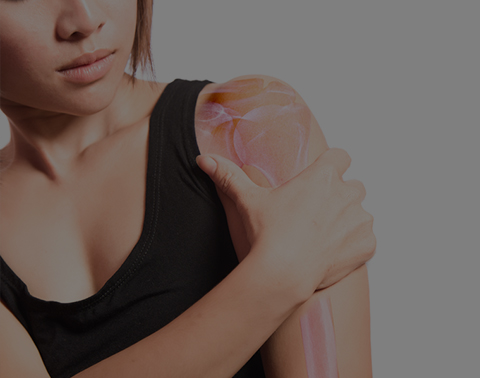
A Stage-Specific, Non-Invasive Approach with the S.H.I.V.A. Method.
How to Choose the Right Physical Therapist: A Patient-Friendly Guide.

Empowering You to Make Informed, Personalized Care Decisions.


 LinkedIn